
Mercurial notifications in Zulip
Get Zulip notifications when you hg push!
-
Create the channel you'd like to use for Mercurial (hg) notifications.
-
Create a bot for Mercurial (hg). Make sure that you select Incoming webhook as the Bot type.
-
Download and install our Python bindings and example scripts on the system where the Mercurial (hg) integration script will be run from.
-
Edit the
.hg/hgrcconfiguration file for this default Mercurial repository and add the following sections, using the credentials for your Mercurial bot and setting the appropriate path to the integration hook if it installs in a different location on this system:[hooks] changegroup = python:zulip_changegroup.hook [zulip] email = hg-bot@example.com api_key = 0123456789abcdefg stream = commits site = https://chat.example.com -
Add the directory where the
zulip_changegroup.pyscript was installed to the environment variablePYTHONPATH. For example, if you installed the Zulip Python bindings at the system level, it'd be:export PYTHONPATH=/usr/local/share/zulip/integrations/hg:$PYTHONPATH
Set site to your organization's HTTPS base URL, without an /api suffix.
That’s all it takes for the basic setup! On the next hg push, you’ll
get a Zulip update for the changeset.
More configuration options
The Mercurial integration also supports:
- linking to changelog and revision URLs for your repository’s web UI
- branch whitelists and blacklists
Web repository links
If you’ve set up your repository to be browsable via the web,
add a web_url configuration option to the zulip section of your
default .hg/hgrc to get changelog and revision links in your Zulip
notifications:
[zulip]
email = hg-bot@example.com
api_key = 0123456789abcdefg
stream = commits
web_url = http://hg.example.com:8000/
site = https://chat.example.com
Branch whitelists and blacklists
By default, this integration will send Zulip notifications for
changegroup events for all branches. If you’d prefer to only receive
Zulip notifications for specified branches, add a branches
configuration option to the zulip section of your default .hg/hgrc,
containing a comma-separated list of the branches that should produce
notifications:
[zulip]
email = hg-bot@example.com
api_key = 0123456789abcdefg
stream = commits
branches = prod,default
You can also exclude branches that you don’t want to cause
notifications. To do so, add an ignore_branches configuration option
to the zulip section of your default .hg/hgrc, containing a
comma-separated list of the branches that should be ignored:
[zulip]
email = hg-bot@example.com
api_key = 0123456789abcdefg
stream = commits
ignore_branches = noisy,even-more-noisy
When team members push new changesets with hg push, you’ll get a
Zulip notification.
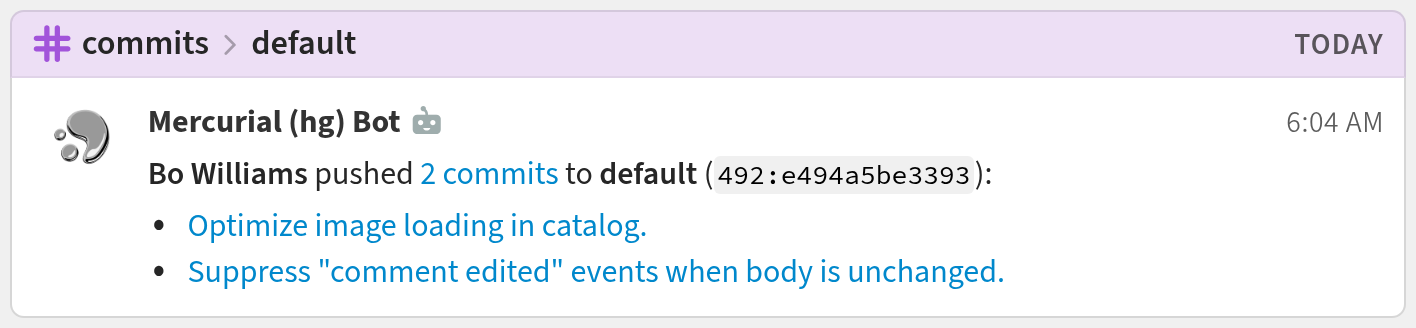
You're done! Your Mercurial (hg) notifications may look like this:
Deployment and access
Run the hook on the repository server with access to the organization's HTTPS API. SaaS, hybrid, on-premises, and carrier-managed deployments require an agreed network route. Separate bots, configuration, and destination channels per customer. Subscribe the bot and grant private-channel access explicitly. Protect the credential files; repository notifications can expose commit subjects, author identities, and links to readers without repository access.
These are post-change notifications, not repository replication, backup, or permission synchronization. The bundled senders do not provide a durable retry queue or prove delivery by completing the hook. Monitor API errors separately. Bot API keys authenticate access; customer-managed BYOK storage keys and their rotation are configured separately.
Logos are trademarks of their respective owners. None of the integrations on this page are created by, affiliated with, or supported by the companies represented by the logos.