
Zulip Statuspage integration
Get Zulip notifications for your Statuspage.io subscriptions!
-
Create a bot for Statuspage. Make sure that you select Incoming webhook as the Bot type.
-
Decide where to send Statuspage notifications, and generate the integration URL.
-
Go to your Statuspage Dashboard, and click on Notifications near the bottom-left corner. Select the Webhook tab. If webhook notifications are disabled, click reactivate webhook notifications now to enable them. Click on the gear () icon next to Subscribers, and select Add subscriber.
-
Set Subscriber type to Webhook. Set Endpoint URL to the URL generated above, and provide an email address. Statuspage will send email notifications to this address if the webhook endpoint fails. Click Add Subscriber.
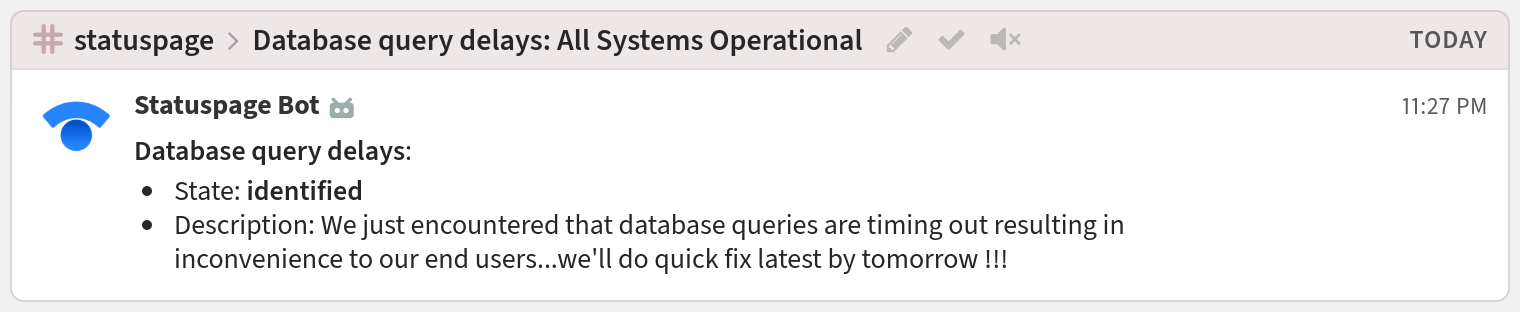
You're done! Your Statuspage notifications may look like this:
Filtering incoming events
The Statuspage integration supports filtering for the following events:
incident, component
Related documentation
In newer Statuspage interfaces, enable Webhook delivery via Subscribers →
Options → Settings, then add a Webhook subscriber. Test an incident
creation/update with subscriber notifications enabled and a separate component
change on a test page. The receiver expects page and either incident or
component/component_update; other status-page services may use different JSON.
For only_events and exclude_events, use incident and component, not
incident statuses. The incident description uses incident_updates[0].body.
Component messages compare old_status and new_status. Default topics
combine the object's name with page.status_description, not a guarantee
that each incident is resolved. A subscriber's email is for delivery problems
and does not replace bot authentication.
Use a bot and URL belonging to your own organization; the URL contains
api_key. Keep it private and use separate bots for different customers.
Payload details may be copied into the channel; review its readers. The
receiver does not verify a separate sender signature or deduplicate delivery
IDs. Retries may create duplicate messages. For SaaS, hybrid, on-premises or
telecom-operated deployments, the sender must reach the organization's HTTPS
URL. Coordinate routing with the operator. Integration credentials are
separate from BYOK encryption keys for storage or backups.
Logos are trademarks of their respective owners. None of the integrations on this page are created by, affiliated with, or supported by the companies represented by the logos.